
Currently viewing
Housing Societies Coverage
Is the IMF Influencing Pakistan’s Real Estate Policy? The Reality, Concerns and the Way Forward
July 11, 2026
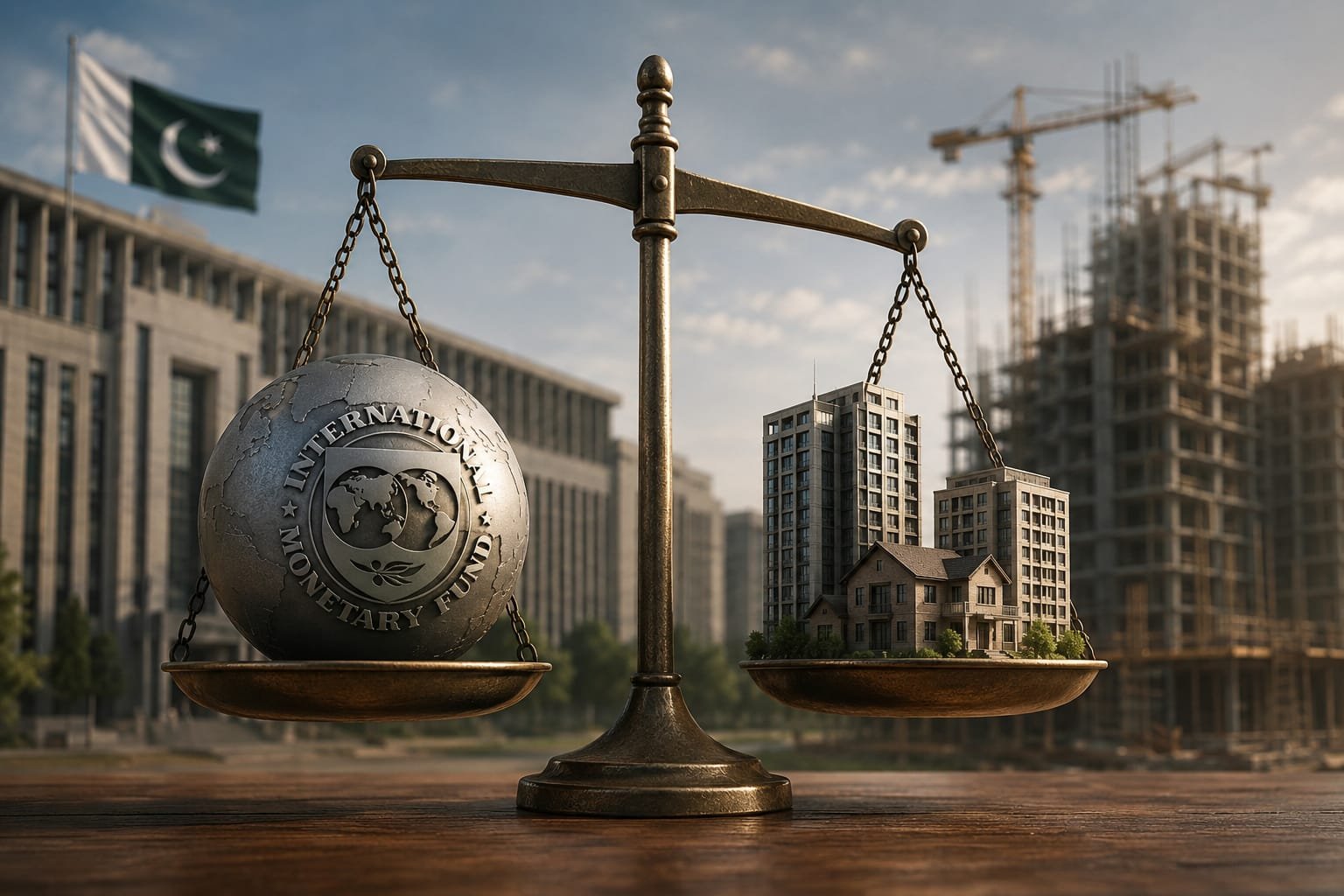
Pakistan’s real estate sector has always played an unusually important role in the national economy. It not only provides employment to millions of people but also supports construction, cement, steel, transportation, banking, architecture and dozens of related industries. For this reason, every government decision concerning real estate affects far more than just investors; its consequences are felt across the wider economy.
Over the past few years, Pakistan’s real estate sector has faced a series of serious challenges. High interest rates, inflation, repeated changes in tax policy, rising construction costs and investor uncertainty have all slowed down market activity. Against this backdrop, the federal government’s decision to introduce certain tax concessions and relief measures for the real estate sector in the 2026–27 budget created fresh optimism in the market. However, reports also emerged that the International Monetary Fund had expressed reservations over some additional proposed concessions, triggering a wider debate over the extent to which the IMF influences Pakistan’s real estate policy.
This question must be examined through facts rather than emotion.
The reality is that Pakistan is currently part of an IMF financial programme. Under such arrangements, borrowing countries are required to meet targets related to fiscal discipline, tax reforms, reduction of budget deficits and improvement in government revenues. Since real estate is one of the largest sectors of Pakistan’s economy and has traditionally remained under-documented, it naturally falls within the scope of these reforms.
The IMF’s central position has been that Pakistan must broaden its tax base, document economic activity more effectively and improve transparency in sectors where significant tax potential exists. In this context, attention is also given to property transactions, asset valuations, investment flows and the taxation structure governing real estate. The stated objective is not necessarily to target one particular sector, but to strengthen overall fiscal stability.
The government and representatives of the real estate industry, however, present a different perspective. They argue that if the sector is burdened with excessive taxation, investment declines, construction activity slows, employment opportunities are reduced and several linked industries also suffer. It was under this reasoning that the recent budget included measures such as reductions in certain withholding taxes on property transactions and the abolition of Section 7E. These steps were widely viewed as positive developments for the construction and property sectors.
The real issue, however, is not simply whether taxes are high or low. The deeper problem is the lack of policy continuity.
Frequent changes in real estate laws and tax policies undermine investor confidence. Concessions are introduced in one year, new restrictions follow in the next, and then another budget changes the framework again. In such an uncertain environment, both domestic and foreign investors become reluctant to make long-term commitments, and the entire sector suffers as a result.
At the same time, several fundamental problems within Pakistan’s real estate market remain unresolved. Illegal housing schemes, land disputes, weaknesses in land records, delays in project approvals, poor urban planning and limited access to housing finance are all major issues. These problems are not directly linked to the IMF; rather, they reflect weaknesses in Pakistan’s own administrative and institutional systems.
A large number of economists agree that Pakistan needs a comprehensive, stable and credible national real estate policy that extends beyond a single budget or one government’s tenure. Such a policy should provide clarity in taxation, continuity in regulations, incentives for productive investment, complete digitisation of land records, effective action against illegal housing projects and wider access to mortgage financing through the banking system.
If these reforms are introduced, Pakistan could attract greater domestic investment while also restoring the confidence of overseas Pakistanis and foreign investors. This would represent a major breakthrough for the country’s housing and construction sectors.
It is also important to understand that the relationship between Pakistan and the IMF cannot be reduced to a simple debate between “relief” and “strictness.” On one side, there is a genuine need for fiscal stability and stronger government revenues. On the other, economic growth, construction activity, employment and investment cannot be ignored. A successful policy must therefore strike a careful balance between these competing priorities.
The future of Pakistan’s real estate sector does not depend solely on reducing or increasing taxes. It depends on transparent laws, consistent policies, stronger institutions and an investor-friendly environment. If the government gives priority to these structural reforms, real estate can play a major role not only in economic recovery but also in building a stronger and more sustainable foundation for long-term national growth.