
Currently viewing
Housing Societies Coverage
Faisalabad’s Industries Are Becoming an Environmental Threat to Urban Communities: Does the Government Now Need to Make a Bold Decision?
August 8, 2026
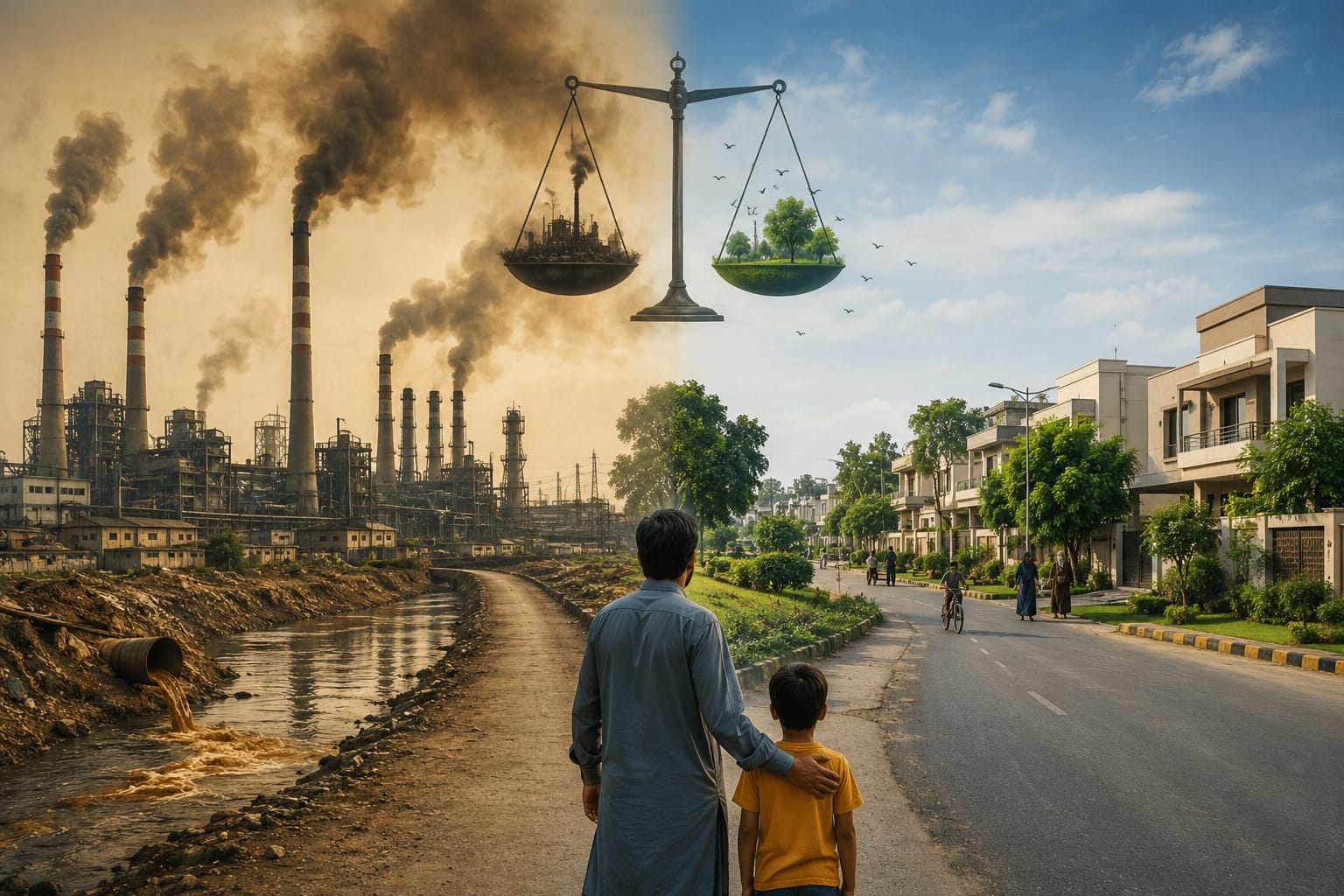
Faisalabad remains one of the most important pillars of Pakistan’s industrial economy, but the growing overlap between its expanding residential areas and industrial units is emerging as a challenge that can no longer be viewed solely through the lens of environmental pollution. The issue now directly intersects with urban planning, land use, real estate, public health and the future direction of industrial development.
Recent figures from a survey conducted by the Environmental Protection Agency (EPA) underline the seriousness of the situation. A total of 782 industrial units are operating across 105 union councils of Faisalabad, providing employment to approximately 43,612 people. However, the more troubling finding is that 568 industrial units are located within just 0.5 kilometres of residential areas, while 441 units are operating either inside populated neighbourhoods or immediately adjacent to them.
This suggests that, in many parts of Faisalabad, the clear physical separation between industrial and residential land uses — a fundamental requirement of orderly and sustainable urban development — has effectively disappeared.
The problem extends beyond factory locations. According to the survey, major risks include emissions from industrial boilers, untreated wastewater, the use of hazardous chemicals and the close proximity of industrial activity to residential communities. Even more concerning is the finding that 734 industrial units are operating without the required No Objection Certificates from the EPA.
The situation raises a fundamental question: has Faisalabad’s urban expansion taken place under a coherent planning framework, or has the city simply allowed industries and residential neighbourhoods to grow around one another in an increasingly unregulated manner?
The district administration’s decision to jointly inspect 441 industrial units and take action against those found violating regulations is an important step. But shutting factories alone cannot provide a sustainable solution, particularly when thousands of families depend on these industries for their livelihoods.
What Faisalabad now needs is a comprehensive industrial relocation policy under which hazardous and non compliant industries are gradually shifted to properly planned industrial zones equipped with adequate infrastructure, wastewater treatment facilities, chemical safety systems, fire protection measures and transport connectivity.
The implications of such a transition could also be significant for Faisalabad’s real estate market.
If industrial units operating within or near residential neighbourhoods are relocated in a planned manner, substantial parcels of urban land could become available for redevelopment under appropriate planning and land-use regulations. These sites could potentially support new residential, commercial or mixed-use projects. Reduced industrial pollution and heavy traffic could also improve the liveability of surrounding neighbourhoods and may, over time, enhance property values.
However, there is also a risk. If land vacated by relocated industries is opened to unplanned commercialisation or high density construction without a comprehensive master plan, the city could end up replacing one urban problem with another.
The real choice before Faisalabad is not between industry and housing. It is about placing both in the right locations.
The city needs its industrial sector because it remains central to its economic strength and provides livelihoods to tens of thousands of people. At the same time, residents have an equally legitimate right to cleaner air, safer neighbourhoods and better urban infrastructure.
If the findings of the current survey are used not merely to issue notices and conduct inspections, but as the foundation for a broader review of Faisalabad’s land use policy and master planning framework, the present environmental challenge could also become an opportunity to reshape the city into a more organised, safer and more valuable urban real estate market.