
Currently viewing
Housing Societies Coverage
Gulf War, Capital Flight from Dubai and a New Turn for Pakistan’s Property Market
September 1, 2026
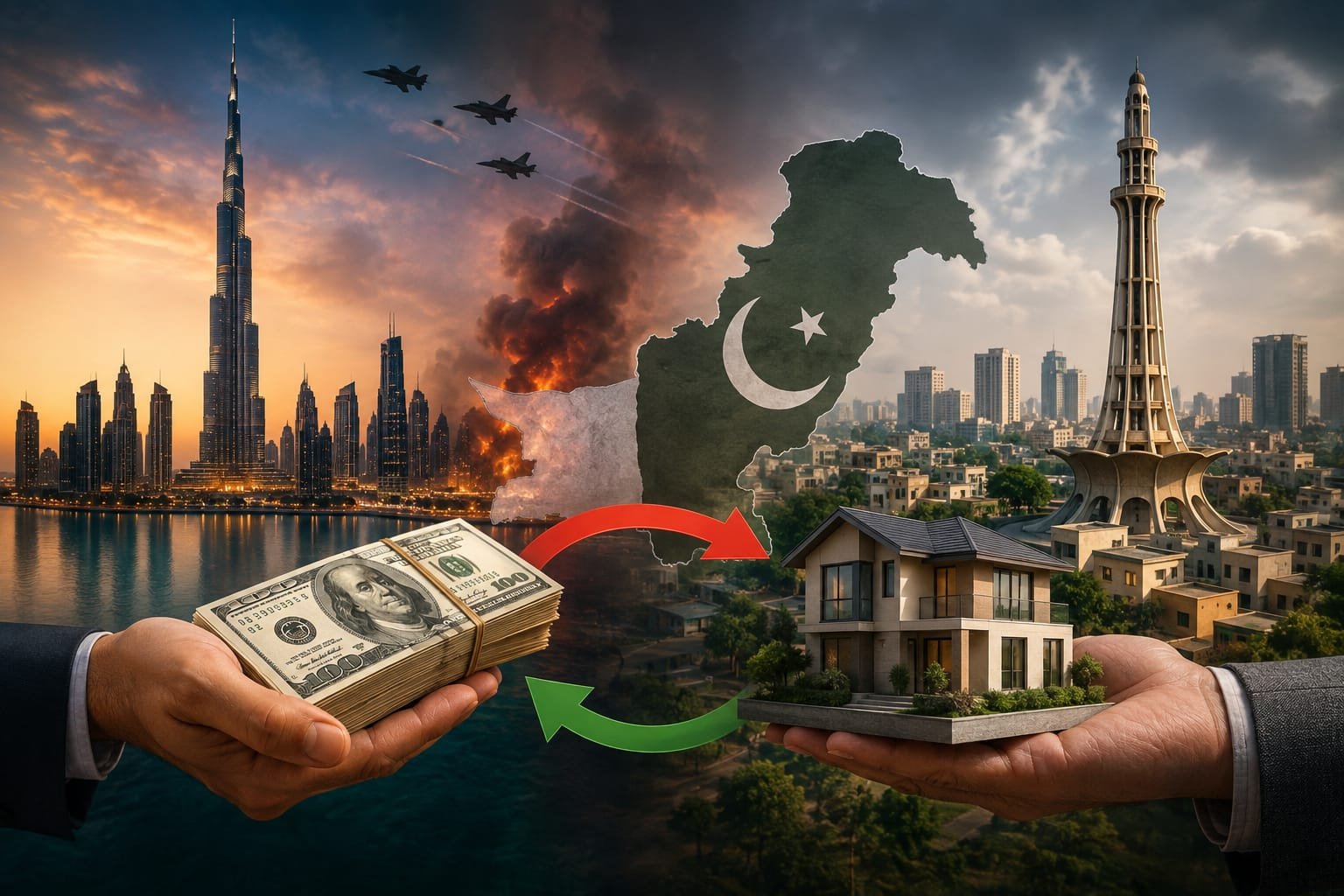
The ongoing Gulf war and growing geopolitical tensions have affected not only the region’s politics and economy but also the investment preferences of Pakistani investors. For years, Dubai has been regarded as a safe and attractive property destination for Pakistani investors. However, the current situation is raising an important question: Is Pakistani capital now beginning to flow back from Dubai to Pakistan?
According to media reports and property market sources, the flow of new capital from Pakistan into Dubai has slowed, while some investors who had previously invested in the UAE’s real estate sector are now considering bringing their funds back to Pakistan and reinvesting in the local market.
The development is significant because Pakistani nationals have long been among the major foreign investors in Dubai’s property market. On several occasions, Pakistani investors have been ranked among the leading foreign buyers of real estate in Dubai, highlighting the scale of their involvement in the UAE’s property sector. Any shift in this investment pattern could therefore have implications for Pakistan’s real estate and construction industries.
Chairman of the All Pakistan Builders Association Hassan Bakshi said that around $60 million in allegedly illegal or undeclared funds were generated in Pakistan every month and subsequently invested in Dubai. According to him, the ongoing conflict and uncertainty in the Gulf region have significantly disrupted this flow.
Currency dealers, meanwhile, say some Pakistani investors are attempting to bring their liquid assets back from Dubai. An increase in remittances from the United Arab Emirates could partly reflect the repatriation of funds by Pakistanis reassessing their investments amid the prevailing geopolitical uncertainty. However, it would be premature to attribute the entire increase in remittances to the return of property investment.
An interesting aspect of this shift is emerging in Pakistan’s domestic property market. Market sources say increased investment in key areas, particularly Defence in Lahore, has contributed to a significant rise in property prices. Hassan Bakshi claimed that property prices in Defence have increased by around 50 to 60 percent since the outbreak of the Gulf war.
Karachi’s property market has also witnessed increased activity, according to property dealers. They report that property values in various parts of the city have risen by around 20 to 25 percent, while improved liquidity has contributed to greater buying and selling activity.
However, it would be premature to describe these developments as a permanent shift in Pakistan’s property market. Investors’ decisions will continue to depend on several factors, including the duration of the conflict, confidence in Dubai’s property market, Pakistan’s economic conditions, exchange-rate stability and government policies.
If geopolitical tensions in the Gulf persist, a portion of Pakistani capital could increasingly look for opportunities in the domestic real estate market instead of being invested abroad. Such a trend could place further pressure on property demand, prices and construction activity in major Pakistani cities.
The Gulf crisis, therefore, may represent more than a geopolitical challenge for Pakistan. It could also trigger a significant change in the flow of investment capital. The key question is whether Pakistan’s property market is prepared to absorb any returning capital and channel it into productive, sustainable and long term real estate investment.