

Belgrade | ReNews International Desk News
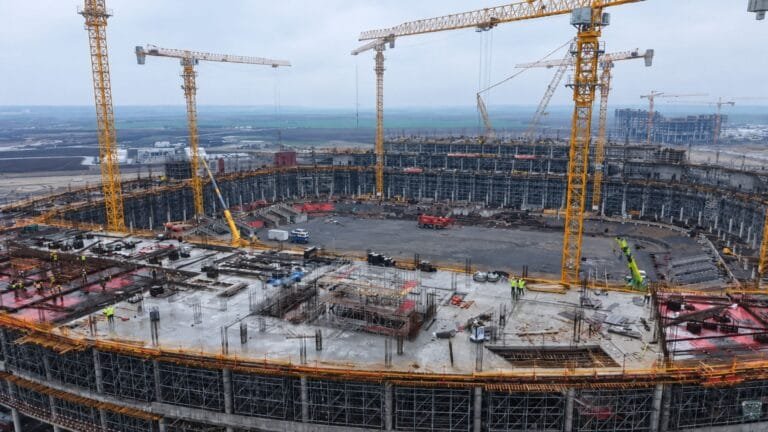
A Chinese state owned construction company has completed the first lifting of the steel structure for Serbia’s National Stadium, marking a major milestone in the development of what is being described as the world’s first “garden stadium.”
The stadium, being built in Surčin, a suburb of Belgrade, is one of Serbia’s most ambitious sports infrastructure projects. Once completed, the arena is expected to seat around 52,000 spectators and serve as the new permanent home of the Serbian national football team.
According to project details, the stadium will cover nearly 76,000 square meters and use approximately 12,600 tons of steel. The most distinctive feature of the arena will be its four large garden rings, designed to surround the stadium through suspended terraces supported by a complex system of steel cables.
Unlike conventional stadiums that rely on concrete or glass facades, Serbia’s National Stadium will be wrapped in greenery. Trees, shrubs, and landscaped leisure spaces will be placed on the terraces, giving the structure the appearance of a floating vertical garden around the football arena.
The project is being executed with the involvement of China State Construction Engineering Corporation, which is responsible for the design, manufacturing, and installation of the stadium’s steel structure. Power Construction Corporation of China is also reported to be participating as a main contractor, further highlighting China’s growing role in major infrastructure projects in the Balkans.
The first steel structure lift is considered an important step because it marks the stage at which the stadium begins to visibly take shape. The project requires advanced engineering calculations due to the combination of steel, soil, irrigation systems, live vegetation, and long-term plant growth.
Serbia has been discussing the idea of a new national stadium since 2013. At that time, the project was estimated at around 250 million euros, and authorities had not yet decided whether to build a new arena or renovate an existing stadium. In 2018, the government decided to construct a new stadium in Surčin.
The cost of the project has since risen significantly, with the final investment now estimated at around 1 billion euros, equivalent to approximately R$ 6 billion. The Serbian government is financing the project, which has drawn attention due to both its cost and its unusual design.
The National Stadium is expected to address a major gap in Serbia’s football infrastructure. At present, the country does not have a stadium that fully meets both FIFA World Cup and UEFA standards for major international competitions.
With a capacity of 52,000 seats, the new arena could allow Serbia to host high profile international matches, including European competition fixtures and potentially matches in future joint tournament bids. It may also be used by leading Serbian clubs such as Red Star and Partizan for major European games.
Construction officially began with a groundbreaking ceremony on May 1, 2024. The project is scheduled for completion by the end of 2026, although its final delivery will depend on whether construction remains on track.
If completed as planned, Serbia’s National Stadium will become one of the most unusual sports venues in the world, combining football, engineering, landscaping, and urban design in a single landmark project.
Published: May 19, 2026 - 12:20 PM
First Installation of Steel Structure Completed for Serbia’s ‘Garden Stadium’ Being Built with Chinese Support
چین کے تعاون سے بننے والا سربیا کا ’گارڈن سٹیڈیم‘ کے سٹیل کے ڈھانچے کی پہلی تنصیب مکمل کر لی گئی
▫️The 52,000 seat stadium being built in Belgrade is being described as a unique architectural project due to its four garden like rings suspended with steel cables
Belgrade | ReNews International Desk News A Chinese state owned construction company has completed the first lifting of the steel structure for Serbia’s National Stadium, marking a major milestone in the development of what is being ...


























