

Lahore | ReNews Pakistan
According to scientific estimates, the universe is approximately 13.8 billion years old. In comparison, the history of human civilisation and organised urban life is remarkably brief. Humanity spent a large part of its existence hunting, gathering food and living in temporary shelters. However, the emergence of agriculture, access to permanent water sources and the need for collective security gradually encouraged people to settle in one place.
These permanent settlements slowly developed into villages, trading centres and eventually major cities.
The earliest urban communities were not limited to residential structures. Defensive walls, places of worship, markets, storage facilities, roads, irrigation systems and administrative buildings began to emerge. Cities were therefore transformed from simple places of residence into centres of economic activity, political authority, religious influence and social organisation.
Jericho: An Early Permanent Settlement and Fortified Community
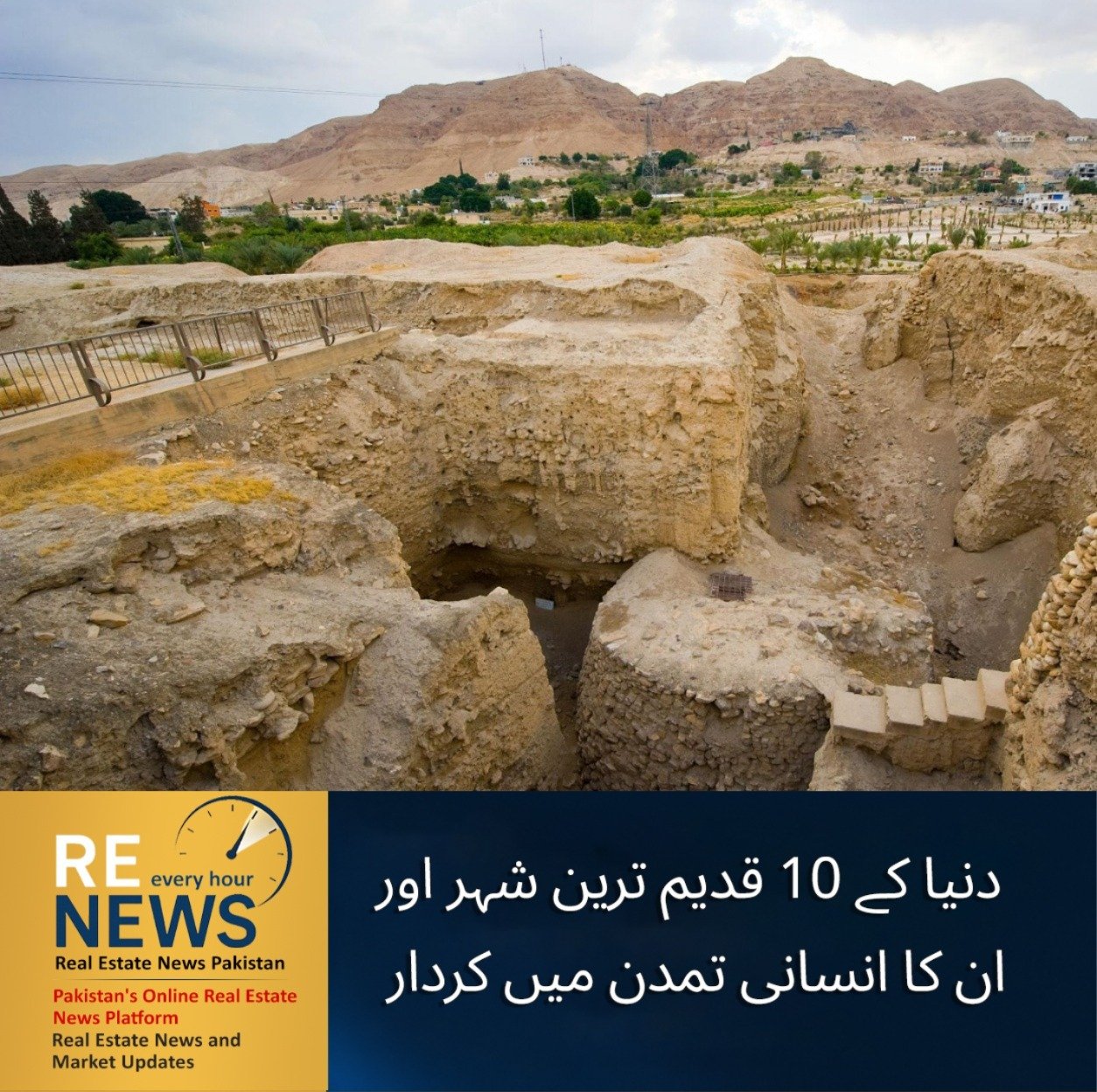
Ancient Jericho, also known as Tell es-Sultan, is located in the Jordan Valley in Palestine and is considered one of the oldest known permanent human settlements in the world. Evidence of human activity at the site dates back to around 10,500 BC, while by the ninth and eighth millennia BC, it had developed into a substantial permanent community.
Archaeological discoveries have revealed evidence of a defensive wall, a surrounding ditch and a tall stone tower. These structures suggest that the people of Jericho had not only adopted a settled way of life but had also developed an understanding of collective defence, construction planning and water management.
The permanent spring of Ain es-Sultan is widely believed to have been the principal reason for the settlement’s establishment and long-term survival.
Jericho is particularly significant because it displays some of the earliest urban features that later became the foundation of city planning: access to water, defensive boundaries, communal buildings and a centrally organised population.
Ur: Mesopotamia’s Organised Urban Centre
Located in southern Iraq, Ur was one of the most prominent Sumerian cities of ancient Mesopotamia. Along with Uruk and Eridu, it developed in the lower Tigris-Euphrates region during the fourth and third millennia BC and became part of one of the world’s earliest urban civilisations.
The presence of residential districts, temples, administrative structures, markets and the monumental Ziggurat of Ur indicates that the city possessed an organised economy alongside established religious and political authority.
Ur experienced periods of prosperity, destruction and resettlement, but its surviving remains continue to demonstrate the architectural skill and urban planning expertise of Mesopotamian civilisation.
Rivers played a fundamental role in the growth of cities such as Ur. Water supported agriculture and transportation, while increased agricultural production generated the resources required for trade, craftsmanship and permanent construction.
Troy: A Fortified City and Meeting Point of Civilisations
Troy was located at Hisarlik in north-western Türkiye, not in modern Greece. Archaeological evidence shows several successive periods of settlement at the site, with its urban history spanning approximately 4,000 years.
Troy’s earliest defensive wall was constructed around 3000 BC. In later periods, the settlement developed a fortified citadel, palaces, administrative buildings and an extensive lower city.
Its geographic location placed it at a strategic point between Anatolia, the Aegean Sea and the Balkans, enabling it to become an important centre of trade and cultural interaction.
Troy gained global fame through Homer’s epic poem, the Iliad. Archaeological discoveries, however, demonstrate that it was not merely a legendary location but a genuine urban centre that was repeatedly built, destroyed and resettled.
Heliopolis: The Religious City of the Sun God
Ancient Heliopolis, situated in the modern Cairo districts of Ain Shams and Matariya, was one of ancient Egypt’s oldest and most influential religious centres.
The city was a major centre for the worship of the sun gods Ra and Atum and was closely associated with important ancient Egyptian beliefs about the creation of the universe.
Its great solar temple, religious scholarship and royal ceremonies gave Heliopolis exceptional importance. Many of its obelisks and stone monuments were later relocated to other parts of Egypt and the Roman world. As a result, only a limited portion of its original urban grandeur survives today.
Heliopolis demonstrates that the growth of ancient cities did not depend solely on trade or military strength. Religious institutions also played a fundamental role in shaping land use, architecture, education and political authority.
Corinth: A Commercial Centre at the Crossroads of Land and Sea
Ancient Corinth was established on the narrow strip of land connecting the Peloponnese with mainland Greece. This strategic position allowed the city to influence both overland transportation and maritime trade between the Aegean and Ionian seas.
Corinth developed significantly because of its ports, markets, craftsmanship and international commerce. The city faced destruction and reconstruction during different historical periods, but its geographical importance repeatedly helped it re-emerge as a major economic and urban centre.
The history of Corinth shows that in the ancient world, land located at the intersection of major trading routes was as important to urban growth and property value as land near highways, ports and transport hubs is today.
Rome: From a Small Settlement to the Capital of a Vast Empire
According to Roman tradition, Rome was founded by Romulus in 753 BC. Historians, however, generally regard the story of Romulus and Remus as a foundation myth rather than a fully verified historical account.
Initially composed of hilltop communities near the River Tiber, Rome gradually developed into an organised city and later became the capital of a vast empire.
Its roads, bridges, aqueducts, public baths, marketplaces, temples and multi-storey residential buildings transformed Roman urban planning into a model for future civilisations.
The rise of Rome illustrates that the strength of a major urban centre does not rest solely in its buildings. It also depends on infrastructure, law, administrative institutions and transportation networks connecting different regions.
Byzantium: A City at the Crossroads of Three Continents
Byzantium was founded by Greek settlers in the seventh century BC on the shores of the Bosphorus Strait. Its location placed it between Europe and Asia and along the maritime route linking the Black Sea with the Mediterranean.
Roman Emperor Constantine later transformed it into the imperial capital of Constantinople. Following the Ottoman conquest, the city, now known as Istanbul, became one of the world’s most important political, commercial and cultural centres.
The history of Byzantium provides a powerful example of how an exceptional geographic location can determine the value of urban land, defensive importance, commercial influence and long-term political status.
Cairo: From a Fatimid Capital to a Centre of Islamic Architecture
Cairo was formally founded in 969 AD by the Fatimid military commander Jawhar al-Siqilli on the orders of Caliph al-Muizz li-Din Allah.
The new city was established near the existing settlements of Fustat and al-Qata’i and became the capital of the Fatimid Caliphate.
Construction of Al-Azhar Mosque also began during this period. It later developed into one of the most important centres of Islamic learning.
With its numerous mosques, religious schools, markets, fortifications and residential neighbourhoods, Cairo eventually became known as the “City of a Thousand Minarets”.
Cairo’s urban history is a story of continuous expansion, with successive rulers adding new neighbourhoods, defensive structures, religious institutions and commercial centres alongside the older city.
Oslo: Rebuilt According to a New Urban Plan After a Devastating Fire
Norway’s capital, Oslo, emerged as a trading settlement during the middle of the 11th century.
Following a major fire in 1624, the city was rebuilt near Akershus Fortress according to a new urban plan. It was renamed Christiania after King Christian IV.
The spelling of the name was later changed, while the historic name Oslo was officially restored in 1925. The original material incorrectly stated that the name was restored in 1995; the correct year is 1925.
Oslo’s reconstruction represents an important example of how disasters can create opportunities for improved urban planning. After the fire, the city was redesigned with greater attention to street layouts, construction materials and defensive requirements.
Moscow: From a Fortified Settlement to the Russian Capital
The earliest written reference to Moscow dates to 1147. It initially developed as a small fortified settlement along the Moskva River.
Its location, commercial activity, defensive importance and role in the unification of surrounding Russian territories gradually transformed it into a powerful political centre.
Moscow suffered extensive damage from Mongol invasions, warfare and repeated fires. A large portion of the city was destroyed during the arrival of Napoleon’s forces in 1812, after which it underwent extensive reconstruction throughout the 19th century.
Moscow’s history shows that the survival of cities does not depend solely on their original construction. Continuous rebuilding of infrastructure, administrative institutions and residential districts after destruction is equally important to urban continuity.
Jamestown: The First Permanent English Settlement in North America
It would be historically inaccurate to describe Jamestown as the first human settlement in the world or even in North America, as Indigenous peoples had lived across the continent for thousands of years.
Jamestown’s historical importance lies in the fact that it was established in 1607 by the Virginia Company of London as the first permanent English settlement in North America.
Settlers arrived aboard three ships — the Susan Constant, the Godspeed and the Discovery — and established a fort and settlement along the James River.
Despite disease, poor-quality water, food shortages and conflict with Indigenous communities, the settlement survived and later became an important centre of the English colonial system.
From Ancient Cities to Modern Urban Planning
Jericho, Ur, Troy, Heliopolis, Corinth, Rome, Byzantium, Cairo, Oslo, Moscow and Jamestown belong to different historical periods and civilisations. However, several common factors shaped their development.
Water resources, fertile land, defensible locations, trading routes, religious institutions and political authority formed the foundations of their growth.
Cities that successfully adapted their buildings, roads and economic functions to changing conditions were repeatedly rebuilt and resettled despite wars, disasters and destruction.
These historic cities also offer fundamental lessons for modern real estate development and urban planning. A city’s long-term sustainability does not depend solely on tall buildings or the scale of construction.
It emerges from a balanced relationship between water, transportation, employment, social institutions, security and the local environment.
The surviving remains of settlements established thousands of years ago continue to remind us that cities are not simply collections of bricks and stones. They are living expressions of human necessity, collective memory and continuous reconstruction.
Published: July 14, 2026 - 11:41 AM
Ten of the World’s Oldest Cities and Their Role in Shaping Human Civilisation
دنیا کے 10 قدیم ترین شہر اور ان کا انسانی تمدن میں کردار
▫️From prehistoric Jericho to Ur, Troy, Rome, Cairo, Oslo, Moscow and Jamestown the story of how human settlements evolved into centres of trade, power, religion and civilisation
Lahore | ReNews PakistanAccording to scientific estimates, the universe is approximately 13.8 billion years old. In comparison, the history of human civilisation and organised urban life is remarkably brief.
























