← Back to home

Arazi Nama

89 news articles

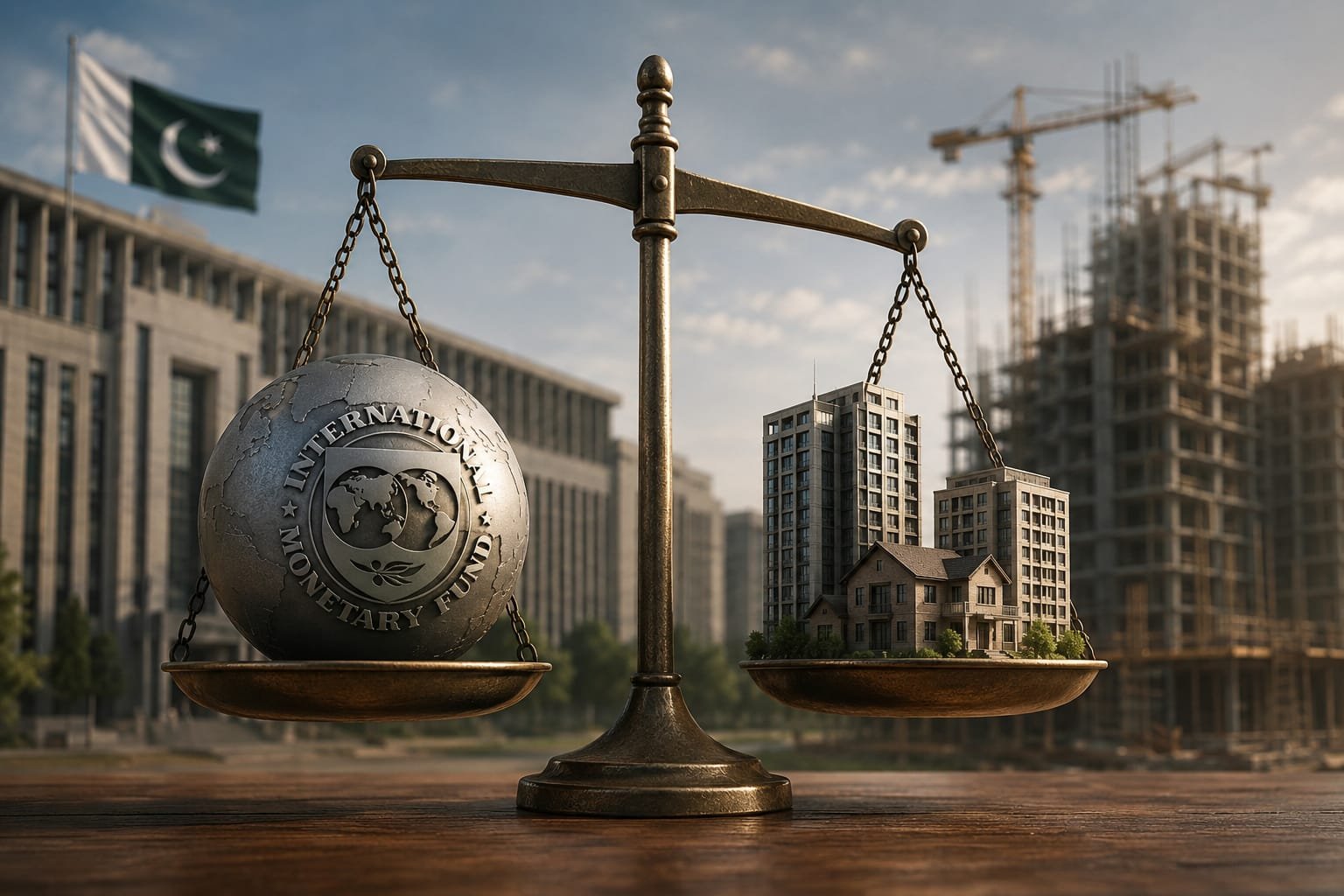
Is the IMF Influencing Pakistan’s Real Estate Policy? The Reality, Concerns and the Way Forward

Is the IMF Influencing Pakistan’s Real Estate Policy? The Reality, Concerns and the Way Forward

Pakistan’s real estate sector has always played an unusually important role in the national economy. It not only provides employment to millions of people but also supports construction, cement, steel, transportation, banking, architecture and dozens of related industries. For this reason, every government decision concerning real estate affects far more than just investors; its consequences are felt across the wider economy.
Over the past few years, Pakistan’s real estate sector has faced a series of serious challenges. High interest rates, inflation, repeated changes in tax policy, rising construction costs and investor uncertainty have all slowed down market activity. Against this backdrop, the federal government’s decision to introduce certain tax concessions and relief measures for the real estate sector in the 2026–27 budget created fresh optimism in the market. However, reports also emerged that the International Monetary Fund had expressed reservations over some additional proposed concessions, triggering a wider debate over the extent to which the IMF influences Pakistan’s real estate policy.
This question must be examined through facts rather than emotion.
The reality is that Pakistan is currently part of an IMF financial programme. Under such arrangements, borrowing countries are required to meet targets related to fiscal discipline, tax reforms, reduction of budget deficits and improvement in government revenues. Since real estate is one of the largest sectors of Pakistan’s economy and has traditionally remained under-documented, it naturally falls within the scope of these reforms.
The IMF’s central position has been that Pakistan must broaden its tax base, document economic activity more effectively and improve transparency in sectors where significant tax potential exists. In this context, attention is also given to property transactions, asset valuations, investment flows and the taxation structure governing real estate. The stated objective is not necessarily to target one particular sector, but to strengthen overall fiscal stability.
The government and representatives of the real estate industry, however, present a different perspective. They argue that if the sector is burdened with excessive taxation, investment declines, construction activity slows, employment opportunities are reduced and several linked industries also suffer. It was under this reasoning that the recent budget included measures such as reductions in certain withholding taxes on property transactions and the abolition of Section 7E. These steps were widely viewed as positive developments for the construction and property sectors.
The real issue, however, is not simply whether taxes are high or low. The deeper problem is the lack of policy continuity.
Frequent changes in real estate laws and tax policies undermine investor confidence. Concessions are introduced in one year, new restrictions follow in the next, and then another budget changes the framework again. In such an uncertain environment, both domestic and foreign investors become reluctant to make long-term commitments, and the entire sector suffers as a result.
At the same time, several fundamental problems within Pakistan’s real estate market remain unresolved. Illegal housing schemes, land disputes, weaknesses in land records, delays in project approvals, poor urban planning and limited access to housing finance are all major issues. These problems are not directly linked to the IMF; rather, they reflect weaknesses in Pakistan’s own administrative and institutional systems.
A large number of economists agree that Pakistan needs a comprehensive, stable and credible national real estate policy that extends beyond a single budget or one government’s tenure. Such a policy should provide clarity in taxation, continuity in regulations, incentives for productive investment, complete digitisation of land records, effective action against illegal housing projects and wider access to mortgage financing through the banking system.
If these reforms are introduced, Pakistan could attract greater domestic investment while also restoring the confidence of overseas Pakistanis and foreign investors. This would represent a major breakthrough for the country’s housing and construction sectors.
It is also important to understand that the relationship between Pakistan and the IMF cannot be reduced to a simple debate between “relief” and “strictness.” On one side, there is a genuine need for fiscal stability and stronger government revenues. On the other, economic growth, construction activity, employment and investment cannot be ignored. A successful policy must therefore strike a careful balance between these competing priorities.
The future of Pakistan’s real estate sector does not depend solely on reducing or increasing taxes. It depends on transparent laws, consistent policies, stronger institutions and an investor-friendly environment. If the government gives priority to these structural reforms, real estate can play a major role not only in economic recovery but also in building a stronger and more sustainable foundation for long-term national growth.
DHA Estate Agents Association Lahore Election Campaign: Leadership, Performance and Dealers’ Expectations

DHA Estate Agents Association Lahore Election Campaign: Leadership, Performance and Dealers’ Expectations

▫️ Riaz Hussain

The election campaign for the DHA Estate Agents Association Lahore offers the real estate community an important opportunity to define its priorities.

Why Is Consumer Protection Weak in Pakistan’s Real Estate Sector, and Where Can Property Investors Seek Justice?

Why Is Consumer Protection Weak in Pakistan’s Real Estate Sector, and Where Can Property Investors Seek Justice?

▫️ Riaz Hussain

For millions of Pakistanis, owning a home is a lifelong dream. However, turning that dream into reality can sometimes put their entire life savings at risk. Many buyers investing in residential and commercial projects face problems such ...

Property Fraud and Misleading Marketing: The Hidden Risks Facing Pakistan’s Real Estate Buyers

Property Fraud and Misleading Marketing: The Hidden Risks Facing Pakistan’s Real Estate Buyers

▫️

Pakistan’s real estate sector attracts billions of rupees in investment every year, but behind glossy advertisements, ambitious master plans and promises of high returns lies a persistent problem: property fraud and misleading marketing.

DHA Lahore’s Phase 9 Prism Moves Toward Greater Residential and Commercial Occupancy

DHA Lahore’s Phase 9 Prism Moves Toward Greater Residential and Commercial Occupancy

DHA Lahore’s Phase 9 Prism has emerged as one of the city’s major residential and commercial developments, with the opening of possession for plots in 2026 marking the beginning of a new phase of development and construction activity.

Property Taxes vs Real Estate: Can Pakistan Find the Right Balance?

Property Taxes vs Real Estate: Can Pakistan Find the Right Balance?

▫️

Pakistan’s real estate sector stands at a difficult crossroads. On one side, the government needs to increase tax revenues, document property ownership and bring more economic activity into the formal tax system. On the other, property b...

What You Should Know Before Buying Property: It’s Not Just About the Documents

What You Should Know Before Buying Property: It’s Not Just About the Documents

Buying property is one of the biggest financial decisions a person can make.When purchasing a house, apartment, plot or any other type of real estate, buyers usually focus on the price, location and ownership documents. But in reality, c...

New Housing Projects Gain Momentum in Pakistan, Transforming Urban Development and Real Estate Landscape

New Housing Projects Gain Momentum in Pakistan, Transforming Urban Development and Real Estate Landscape

▫️

Pakistan’s housing sector is witnessing increased activity as population growth, urban expansion and rising demand for residential facilities continue to drive the development of new housing projects across the country.

From Building Plan Approval to Safer Structures: Why Building Code Enforcement Matters in Pakistan

From Building Plan Approval to Safer Structures: Why Building Code Enforcement Matters in Pakistan

▫️

Pakistan’s major cities are witnessing a steady increase in high-rise buildings, residential developments, commercial plazas and housing societies.

Crackdown on Illegal Housing Societies in Islamabad: How Can Billions of Rupees Invested by Citizens Be Protected?

Crackdown on Illegal Housing Societies in Islamabad: How Can Billions of Rupees Invested by Citizens Be Protected?

▫️Crackdown on Illegal Housing Societies in Islamabad: How Can Billions of Rupees Invested by Citizens Be Protected?

Recent action against illegal housing societies in Islamabad has once again raised a critical question: How do such societies emerge in the federal capital, who is responsible for monitoring them, and what role should state institutions ...

Is the IMF Influencing Pakistan’s Real Estate Policy? The Reality, Concerns and the Way Forward

Is the IMF Influencing Pakistan’s Real Estate Policy? The Reality, Concerns and the Way Forward

Pakistan’s real estate sector has always played an unusually important role in the national economy. It not only provides employment to millions of people but also supports construction, cement, steel, transportation, banking, architecture and dozens of related industries. For this reason, every government decision concerning real estate affects far more than just investors; its consequences are felt across the wider economy.
Over the past few years, Pakistan’s real estate sector has faced a series of serious challenges. High interest rates, inflation, repeated changes in tax policy, rising construction costs and investor uncertainty have all slowed down market activity. Against this backdrop, the federal government’s decision to introduce certain tax concessions and relief measures for the real estate sector in the 2026–27 budget created fresh optimism in the market. However, reports also emerged that the International Monetary Fund had expressed reservations over some additional proposed concessions, triggering a wider debate over the extent to which the IMF influences Pakistan’s real estate policy.
This question must be examined through facts rather than emotion.
The reality is that Pakistan is currently part of an IMF financial programme. Under such arrangements, borrowing countries are required to meet targets related to fiscal discipline, tax reforms, reduction of budget deficits and improvement in government revenues. Since real estate is one of the largest sectors of Pakistan’s economy and has traditionally remained under-documented, it naturally falls within the scope of these reforms.
The IMF’s central position has been that Pakistan must broaden its tax base, document economic activity more effectively and improve transparency in sectors where significant tax potential exists. In this context, attention is also given to property transactions, asset valuations, investment flows and the taxation structure governing real estate. The stated objective is not necessarily to target one particular sector, but to strengthen overall fiscal stability.
The government and representatives of the real estate industry, however, present a different perspective. They argue that if the sector is burdened with excessive taxation, investment declines, construction activity slows, employment opportunities are reduced and several linked industries also suffer. It was under this reasoning that the recent budget included measures such as reductions in certain withholding taxes on property transactions and the abolition of Section 7E. These steps were widely viewed as positive developments for the construction and property sectors.
The real issue, however, is not simply whether taxes are high or low. The deeper problem is the lack of policy continuity.
Frequent changes in real estate laws and tax policies undermine investor confidence. Concessions are introduced in one year, new restrictions follow in the next, and then another budget changes the framework again. In such an uncertain environment, both domestic and foreign investors become reluctant to make long-term commitments, and the entire sector suffers as a result.
At the same time, several fundamental problems within Pakistan’s real estate market remain unresolved. Illegal housing schemes, land disputes, weaknesses in land records, delays in project approvals, poor urban planning and limited access to housing finance are all major issues. These problems are not directly linked to the IMF; rather, they reflect weaknesses in Pakistan’s own administrative and institutional systems.
A large number of economists agree that Pakistan needs a comprehensive, stable and credible national real estate policy that extends beyond a single budget or one government’s tenure. Such a policy should provide clarity in taxation, continuity in regulations, incentives for productive investment, complete digitisation of land records, effective action against illegal housing projects and wider access to mortgage financing through the banking system.
If these reforms are introduced, Pakistan could attract greater domestic investment while also restoring the confidence of overseas Pakistanis and foreign investors. This would represent a major breakthrough for the country’s housing and construction sectors.
It is also important to understand that the relationship between Pakistan and the IMF cannot be reduced to a simple debate between “relief” and “strictness.” On one side, there is a genuine need for fiscal stability and stronger government revenues. On the other, economic growth, construction activity, employment and investment cannot be ignored. A successful policy must therefore strike a careful balance between these competing priorities.
The future of Pakistan’s real estate sector does not depend solely on reducing or increasing taxes. It depends on transparent laws, consistent policies, stronger institutions and an investor-friendly environment. If the government gives priority to these structural reforms, real estate can play a major role not only in economic recovery but also in building a stronger and more sustainable foundation for long-term national growth.
DHA Estate Agents Association Lahore Election Campaign: Leadership, Performance and Dealers’ Expectations

DHA Estate Agents Association Lahore Election Campaign: Leadership, Performance and Dealers’ Expectations

▫️ Riaz Hussain

The election campaign for the DHA Estate Agents Association Lahore offers the real estate community an important opportunity to define its priorities.

Why Is Consumer Protection Weak in Pakistan’s Real Estate Sector, and Where Can Property Investors Seek Justice?

Why Is Consumer Protection Weak in Pakistan’s Real Estate Sector, and Where Can Property Investors Seek Justice?

▫️ Riaz Hussain

For millions of Pakistanis, owning a home is a lifelong dream. However, turning that dream into reality can sometimes put their entire life savings at risk. Many buyers investing in residential and commercial projects face problems such ...

Property Fraud and Misleading Marketing: The Hidden Risks Facing Pakistan’s Real Estate Buyers

Property Fraud and Misleading Marketing: The Hidden Risks Facing Pakistan’s Real Estate Buyers

▫️

Pakistan’s real estate sector attracts billions of rupees in investment every year, but behind glossy advertisements, ambitious master plans and promises of high returns lies a persistent problem: property fraud and misleading marketing.

DHA Lahore’s Phase 9 Prism Moves Toward Greater Residential and Commercial Occupancy

DHA Lahore’s Phase 9 Prism Moves Toward Greater Residential and Commercial Occupancy

DHA Lahore’s Phase 9 Prism has emerged as one of the city’s major residential and commercial developments, with the opening of possession for plots in 2026 marking the beginning of a new phase of development and construction activity.

Property Taxes vs Real Estate: Can Pakistan Find the Right Balance?

Property Taxes vs Real Estate: Can Pakistan Find the Right Balance?

▫️

Pakistan’s real estate sector stands at a difficult crossroads. On one side, the government needs to increase tax revenues, document property ownership and bring more economic activity into the formal tax system. On the other, property b...

What You Should Know Before Buying Property: It’s Not Just About the Documents

What You Should Know Before Buying Property: It’s Not Just About the Documents

Buying property is one of the biggest financial decisions a person can make.When purchasing a house, apartment, plot or any other type of real estate, buyers usually focus on the price, location and ownership documents. But in reality, c...

New Housing Projects Gain Momentum in Pakistan, Transforming Urban Development and Real Estate Landscape

New Housing Projects Gain Momentum in Pakistan, Transforming Urban Development and Real Estate Landscape

▫️

Pakistan’s housing sector is witnessing increased activity as population growth, urban expansion and rising demand for residential facilities continue to drive the development of new housing projects across the country.

From Building Plan Approval to Safer Structures: Why Building Code Enforcement Matters in Pakistan

From Building Plan Approval to Safer Structures: Why Building Code Enforcement Matters in Pakistan

▫️

Pakistan’s major cities are witnessing a steady increase in high-rise buildings, residential developments, commercial plazas and housing societies.

Crackdown on Illegal Housing Societies in Islamabad: How Can Billions of Rupees Invested by Citizens Be Protected?

Crackdown on Illegal Housing Societies in Islamabad: How Can Billions of Rupees Invested by Citizens Be Protected?

▫️Crackdown on Illegal Housing Societies in Islamabad: How Can Billions of Rupees Invested by Citizens Be Protected?

Recent action against illegal housing societies in Islamabad has once again raised a critical question: How do such societies emerge in the federal capital, who is responsible for monitoring them, and what role should state institutions ...

More Real Estate News

National Real Estate News

See All →

City and District Real Estate News

See All →

Global Real Estate News

See All →

Corporate Real Estate News

See All →

Social Real Estate News

See All →

Real Estate Insights

See All →