Currently viewing
Housing Societies Coverage
What Happened to the Properties Muslims Left Behind in India in 1947?
August 15, 2026
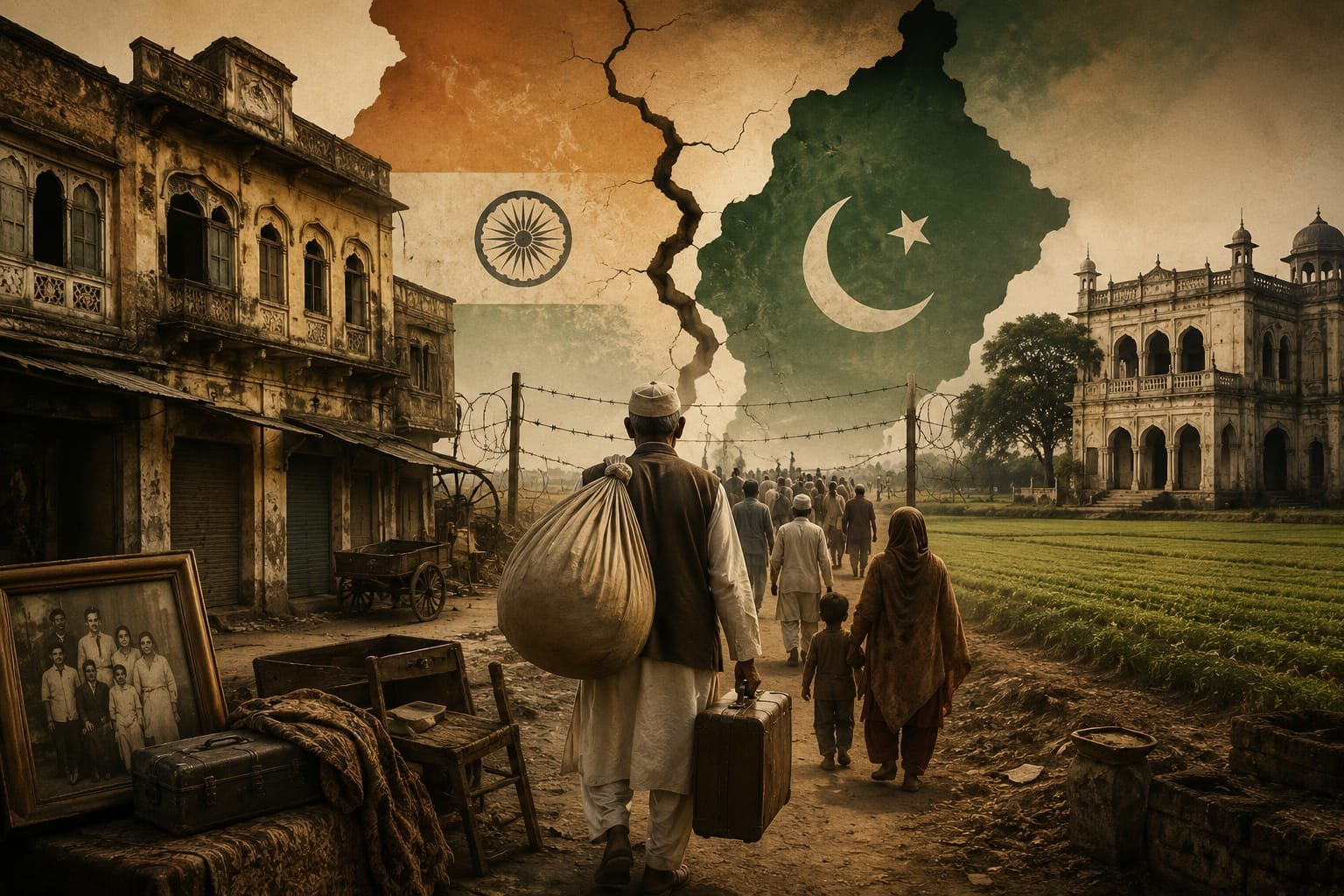
The Partition of India is generally remembered for mass migration, communal violence and the drawing of new borders. But another major consequence of 1947 receives far less attention: what happened to the homes, shops, farmland, businesses and other properties worth enormous sums that people left behind on the other side of the border?
Imagine a family that owns a house in Delhi, shops in Lucknow and agricultural land in Amritsar. These assets may have been built up over several generations. Then 1947 arrives, violence spreads and survival becomes the immediate priority.
The family locks its home, takes only the most essential belongings and leaves for Pakistan. At the time, it may be believed that the displacement is temporary and that it will return once conditions improve. But the border becomes permanent, and the return never happens.
That raises a fundamental question: what became of the property left behind?
Did the Indian government take control of it? Was it allotted to other people? Could Muslims who migrated to Pakistan later reclaim their assets? And, most importantly, did all such property eventually fall under India’s well-known Enemy Property Act?
To understand the issue, it is important to distinguish between two different legal phases: the immediate aftermath of Partition in 1947 and the period following the India-Pakistan wars of 1965 and 1971.
In 1947, property left behind by Muslims who migrated from India to Pakistan was not automatically classified as Enemy Property. The principal legal category was Evacuee Property.
India later formalised this system through the Administration of Evacuee Property Act, 1950. The law covered people who had left India after March 1, 1947, under circumstances linked to Partition, communal disturbances or fear of such violence.
In practical terms, this meant that a house left behind in Delhi, Amritsar, Lucknow or elsewhere was not simply treated as an abandoned building. It could be formally declared Evacuee Property and placed under the administration of a Custodian, a government-appointed authority responsible for managing such assets.
Partition, therefore, created not only a humanitarian crisis but also a vast legal and administrative challenge involving land, buildings and ownership rights.
Pakistan faced a similar problem.
Just as large numbers of Muslims left homes, farms and businesses in India and moved to Pakistan, many Hindus and Sikhs migrated in the opposite direction, leaving behind residential, commercial and agricultural property in the areas that became Pakistan.
The newly created Pakistani state had to manage these abandoned properties while also dealing with the enormous task of resettling incoming refugees. In later years, certain religious, charitable and educational properties linked to evacuee trusts came under the management of the Evacuee Trust Property Board.
Partition, therefore, was not merely a transfer of populations. It also disrupted property ownership on an extraordinary scale on both sides of the new border.
The legal story changed significantly nearly two decades later.
In 1965, India and Pakistan went to war. At that point, the issue was no longer simply about people who had migrated during Partition. The two countries were now formally at war.
Certain movable and immovable assets belonging to Pakistani nationals in India were placed under the Custodian of Enemy Property for India. A similar legal framework was also applied in the context of the 1971 war.
India gave this system a permanent statutory basis through the Enemy Property Act, 1968.
This distinction is crucial.
Evacuee Property arising from Partition in 1947 and Enemy Property linked to later wartime legislation were not legally the same thing.
It is therefore inaccurate to say that every property left behind by a Muslim who migrated to Pakistan in 1947 was confiscated under the Enemy Property Act. The most obvious reason is that the Enemy Property Act itself was enacted only in 1968.
Another important development came after the 1965 war.
In January 1966, India and Pakistan signed the Tashkent Declaration. The agreement included provisions for continued discussion on property and assets taken over by both sides in connection with the conflict.
However, the issue was never resolved in a way that simply restored every house, shop or parcel of land to the family that had originally owned it.
As the decades passed, the legal questions became even more complicated.
Consider a case in which a Pakistani national owned property in India that had been classified as Enemy Property. The original owner later died, but some of his or her legal heirs were Indian citizens.
Could those heirs inherit the property?
This question became the subject of litigation and political debate in India.
In 2017, significant amendments were made to India’s enemy property law. The amended framework made the legal position considerably stricter. It clarified that property vested in the Custodian would not automatically cease to be Enemy Property merely because the original owner had died, changed nationality or left behind heirs who were Indian citizens.
In effect, the owner could die, generations could change, but the legal status of the property could remain intact.
This is what makes the property history of Partition so complex.
For a family, a house in Delhi or Lucknow might have remained an ancestral home filled with memories of childhood, business and generations of family life.
For the state, however, that same house could eventually become part of an entirely different legal and administrative category.
For the family, it remained a memory.
For the government, it became a legal file.
The story of 1947, therefore, cannot be fully understood simply by saying that millions of people moved from India to Pakistan and from Pakistan to India.
They did not cross the border carrying only a few clothes and boxes. They also left behind homes, mansions, farmland, shops, businesses and wealth accumulated over generations.
The same was true of Hindu and Sikh families who migrated from Pakistan to India.
That is why the history of Partition is not only a story of religion, politics and borders. It is also a story of land, ownership, law, citizenship and inheritance.
Partition divided people.
The wars of 1965 and 1971 added another layer of legal complexity.
And the laws that followed determined the fate of properties whose original owners — and, in many cases, several generations of their descendants — had long since moved to the other side of the border.
So perhaps the biggest question is not only who went where in 1947.
It is also this:
What ultimately happened to the billions worth of homes, land, shops and businesses they left behind?