Islamabad | ReNews Pakistan
The Capital Development Authority (CDA) has announced a comprehensive plan to tackle flash flooding in Islamabad after heavy monsoon rainfall caused widespread flooding across several parts of the capital, while violations of the city’s master plan and encroachments along natural drainage channels have emerged as major factors behind the worsening situation.
Islamabad received around 150 millimetres of rain, triggering flash floods that severely affected E-11, Park Road near Comsats and Ghauri Town. CDA and Islamabad Capital Territory (ICT) teams remained in the field to clear roads and restore traffic movement, while CDA Chairman Sohail Ashraf visited E-11, Ghauri Town and other affected areas along with the deputy commissioner.
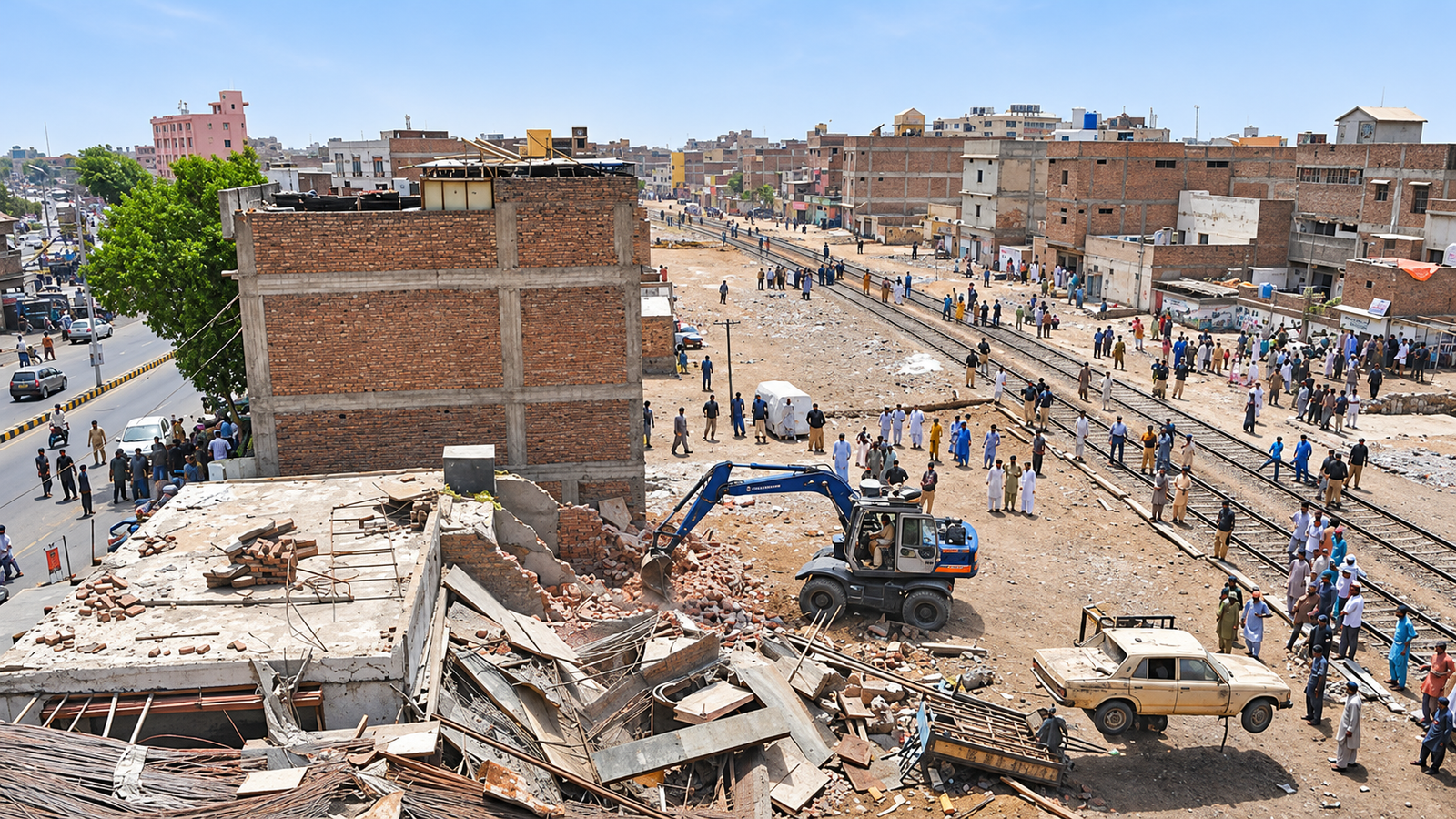
An assessment of the affected areas indicates that the situation has been aggravated by changes to the routes of natural nullahs and the narrowing of their designated rights of way due to construction and development.
Sector E-11, which witnessed the deaths of a mother and child during flooding in 2021, was again badly affected by flash floods. However, no loss of life was reported during the latest episode after the administration had already sealed some houses and basements considered vulnerable to flooding.
E-11 is an unacquired area containing several private housing schemes. Reports indicate that two natural nullahs passing through the area have been significantly narrowed to facilitate construction and create additional plots.
One nullah entering E-11 from D-12 was reportedly reduced from around 40 feet to approximately 18 feet by a housing society in 2012. The CDA also allowed the nullah to be covered. Before entering E-11, the same nullah reportedly had a right of way of around 100 feet, but its width decreases sharply to about 18 feet inside the sector, where a sharp bend further restricts the flow of water.
Another nullah entering E-11 from the E-10 side has also reportedly been narrowed. The convergence of the two drainage channels has created a bottleneck, increasing the pressure of stormwater and contributing to flooding in surrounding areas.
The situation has raised further concerns because E-11 has experienced rapid construction, including unauthorised high-rise and apartment buildings. Several cooperative housing societies are also located in the sector, with some reportedly lacking valid layout plans.
Park Road near Comsats was another badly affected location, where the Gumrah Kas nullah overflowed and floodwater entered the basements of houses and disrupted traffic. Satellite imagery from 2005 and 2026 reportedly shows substantial changes to the nullah’s original route.
The drainage channel previously passed through private land but now runs through CDA-acquired land, while construction has taken place along portions of its former alignment.
Ghauri Town, an unauthorised housing society, also experienced flooding as two natural nullahs passed through the locality. Both drainage channels have reportedly been narrowed to accommodate construction, restricting the natural movement of stormwater.
The flooding has also revived questions about the proposed Lohi Bher Lake. The architects who prepared Islamabad’s original master plan in 1960 had proposed a lake or dam in the low-lying area to store rainwater and help control flooding. However, the CDA did not acquire the land required for the project.
The proposed site has subsequently become part of two private housing schemes, the Jammu Kashmir Farming Scheme and Gulberg Housing Scheme, effectively eliminating the possibility of developing the originally planned water-storage facility without resolving complex land-use and ownership issues.
Beyond E-11, Park Road and Ghauri Town, rainwater accumulated on several major roads and affected areas of the I-series sectors. Sector D-12 was also badly hit, particularly its markaz, where the basements of several commercial buildings, including City Centre, Family Mart Plaza, Aim Centre and Swiss Centre Plaza, were flooded.
The flooding caused substantial losses for traders, who have demanded the development of an effective drainage system in D-12 to prevent similar incidents in the future.
The latest flooding has also renewed debate over Islamabad’s changing land-use patterns and the loss of green areas. Through an amendment to the master plan in the 1990s, the CDA changed the status of Zone IV from a green area to a residential zone, paving the way for the development of numerous housing schemes.
Environmental concerns have intensified alongside this urban expansion. According to Global Forest Watch, Islamabad lost approximately 14 hectares of tree cover between 2001 and 2025.
CDA Chairman Sohail Ashraf said the authority had now prepared a comprehensive strategy to address flash flooding and improve the capital’s water-management capacity.
He said four new check dams would be constructed at the foothills of the Margalla Hills to store rainwater and reduce the risk of flash floods. A new nullah would also be constructed in E-11 to facilitate the smooth flow of stormwater.
The chairman said the CDA would remove constructions built within the rights of nullahs in Ghauri Town and other affected areas. He also said the authority would examine the alignment of Gumrah Kas and seek input on the proposed Lohi Bher Lake.
Ashraf stressed that Islamabad, despite facing water shortages, was failing to adequately store rainwater. He said the proposed dams could help address both problems by reducing flood risks while increasing the availability of stored water.
He said the recent crisis should be treated as an opportunity to introduce long-term reforms in the capital’s drainage and water-management systems, including restoring the rights of way of nullahs and increasing rainwater storage capacity.
The CDA chairman also credited preventive action in E-11 for avoiding fatalities during the latest flooding, saying the sealing of vulnerable basements and houses helped protect residents.
The latest episode has highlighted the consequences of weak enforcement of Islamabad’s planning regulations, narrowing of natural drainage channels, construction in vulnerable areas and insufficient rainwater-storage infrastructure. The success of the CDA’s proposed measures will largely depend on their implementation, enforcement against illegal construction and restoration of the capital’s natural drainage network.

Published: September 5, 2026 - 9:01 AM
Master Plan Violations Worsen Islamabad Flooding as CDA Unveils Flood Control Plan
اسلام آباد میں ماسٹر پلان کی خلاف ورزیاں سیلاب کی شدت میں اضافے کا باعث، سی ڈی اے کا فلڈ کنٹرول پلان متعارف
▫️CDA plans four check dams and a new nullah in E-11, vows action against construction along drainage routes
Islamabad | ReNews PakistanThe Capital Development Authority (CDA) has announced a comprehensive plan to tackle flash flooding in Islamabad after heavy monsoon rainfall caused widespread flooding across several parts of the capital, whil...