Islamabad | ReNews Pakistan
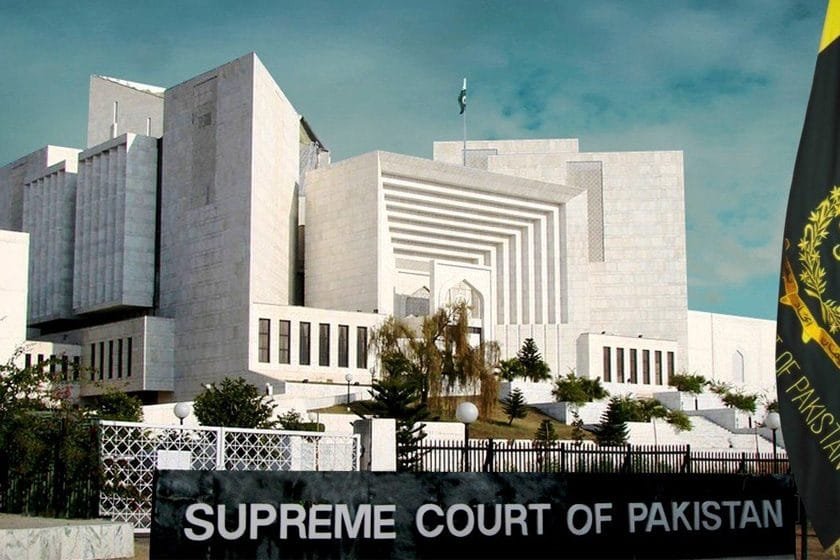
The Supreme Court has issued an important ruling on property sale agreements, holding that time cannot be treated as an essential condition in an agreement involving immovable property unless the parties have expressly agreed to make it a mandatory condition and the loss resulting from the delay is also established.
A three-member bench comprising Chief Justice Yahya Afridi, Justice Irfan Saadat Khan and Justice Aqeel Ahmed Abbasi delivered the ruling while hearing civil petitions concerning Plots No. 311 and 312 in Margalla Town Phase-II, Islamabad. The court dismissed the petitions filed by Bashir Ahmed and Javed Iqbal, finding no legal basis to interfere with the Islamabad High Court’s judgment and declining to grant leave to appeal.
According to the judgment authored by Justice Aqeel Ahmed Abbasi, the parties had entered into an agreement on March 19, 2002, for the sale of Plots No. 311 and 312 for a total consideration of Rs. 1.4 million, while Rs. 220,000 had been paid as earnest money.
The court held that a party cannot be relieved of its contractual obligations merely because time has elapsed in an agreement concerning immovable property. For time to be treated as an essential condition, it must be established that the parties had expressly agreed to make it a fundamental and mandatory term and that the delay resulted in demonstrable loss.
The Supreme Court also laid down an important principle regarding joint property sale agreements, ruling that where the properties belonging to multiple sellers under a single agreement are separate, identifiable and divisible, an agreement concerning one seller’s property can be enforced if that seller has acknowledged the transaction relating to his own property.
According to the court, owner of Plot No. 312, Bashir Ahmed, had expressly admitted in his written response that he had entered into the agreement, received the earnest money and agreed to sell his plot. Therefore, he could not withdraw from his contractual obligations merely on the ground that the agreement concerning the property of the other co-seller, Muhammad Saleem, could not be established.
The Supreme Court observed that once a seller has acknowledged the agreement concerning his specific and divisible property and admitted receiving earnest money, he cannot be permitted to evade his contractual obligations on the basis of circumstances relating to another co-seller’s property.
The three-member bench dismissed both civil petitions after finding no legal justification to interfere with the Islamabad High Court’s decision and declined to grant the petitioners leave to appeal.
The ruling sets out important legal principles concerning time conditions, earnest money, admissions by contracting parties and contractual obligations relating to separately identifiable and divisible immovable property in real estate transactions.
Published: September 19, 2026 - 12:01 PM
Supreme Court Issues Key Ruling: Time Cannot Be Treated as an Essential Condition in Real Estate Agreements
سپریم کورٹ کا اہم فیصلہ: غیر منقولہ جائیداد کے معاہدے میں وقت کو بنیادی شرط قرار نہیں دیا جا سکتا
▫️Clear consent of the parties and proof of loss are required; liability remains enforceable against a seller for his separately identifiable and divisible property, court rules
Islamabad | ReNews PakistanThe Supreme Court has issued an important ruling on property sale agreements, holding that time cannot be treated as an essential condition in an agreement involving immovable property unless the parties have e...