Pakistan’s rapidly expanding rooftop and distributed solar market is beginning to reshape not only the country’s energy system but also the economics of residential, commercial and industrial property. According to new analysis by the Pakistan Solar Association, distributed solar supplied nearly 27% of all electricity generated in Pakistan during fiscal year 2025, with approximately 51 terawatt-hours of generation not appearing in official grid side data.
The gap exists because a large share of Pakistan’s solar capacity is installed behind the meter, on homes, shops, offices, factories and agricultural properties. Electricity generated by these systems can be consumed directly on site without passing through the conventional grid, meaning distribution companies do not see the full scale of generation or underlying electricity consumption.
One of the clearest signs of the transformation can be seen in electricity demand patterns. Analysis of half hourly data from Lahore Electric Supply Company shows a rapidly deepening decline in grid demand during peak sunlight hours.
According to the Pakistan Solar Association, the midday demand profile was relatively flat at around 2.2 GW in 2024, but fell to approximately 765 MW in 2026. At the same time, demand rises sharply into the evening as solar generation declines, with the LESCO network recording an increase of more than 1.1 GW over roughly four hours.
The pattern demonstrates how rooftop solar is changing the traditional relationship between electricity consumption and the national grid.
The implications extend well beyond electricity markets. Pakistan’s solar expansion is increasingly turning rooftops into productive economic assets.
For residential property, a roof with sufficient space and structural capacity for solar panels can become an additional selling point. Homes capable of generating their own electricity may become increasingly attractive to buyers and tenants facing high utility costs.
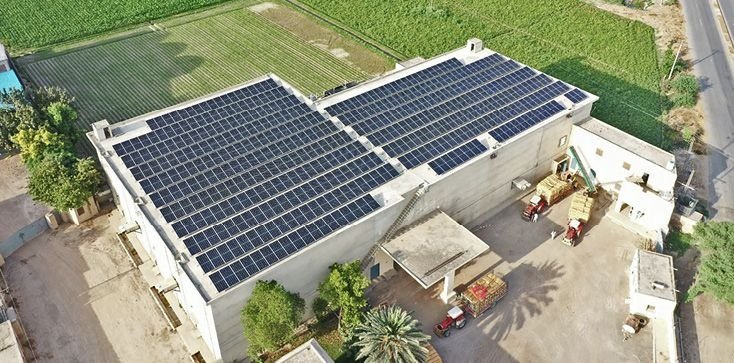
The same trend is potentially even more significant in commercial and industrial real estate. Warehouses, factories, retail buildings and large office properties often have extensive roof areas that can be converted into distributed generation assets.
This creates a new dimension of property value: not simply how much floor space a building provides, but how much energy it can generate and how much electricity it can consume directly.
The Pakistan Solar Association also warns that the challenge is not limited to unrecorded generation. Parts of new electricity demand are also becoming less visible to network operators.
The growing electrification of two and three wheeled vehicles, which account for a significant portion of Pakistan’s electric vehicle transition, could create additional electricity demand that needs to be incorporated into future network planning.
This means Pakistan is experiencing two changes simultaneously: conventional grid demand is being displaced by behind the meter solar, while new forms of electricity consumption are emerging across homes, businesses and transport.
The association argues that failing to accurately capture distributed generation and new demand can lead to forecasting errors and inefficient investment in generation and network infrastructure.
Its research paper, Pakistan’s Solar Revolution: Scale, Blind Spots, and the Path to DER Aware Planning, recommends that Pakistan draw lessons from international approaches, including Australia’s integrated system planning and the United Kingdom’s focus on flexibility across transmission and distribution networks.
The central issue is visibility. A grid designed around a relatively predictable flow of electricity from large power plants to consumers becomes harder to manage when millions of properties begin producing electricity themselves.
For Pakistan’s real estate industry, the solar transition could gradually make energy performance a more important component of property value.
Developers may increasingly need to consider rooftop capacity, solar orientation, energy storage, electrical infrastructure and building efficiency when designing new projects. Buyers and investors may also begin evaluating properties according to their ability to reduce dependence on grid electricity.
This could eventually create a new category of property differentiation: buildings that are not only well located and efficiently designed, but also capable of generating and storing a meaningful share of their own electricity.
Pakistan’s solar adoption has been driven by a combination of high electricity costs, cheaper solar modules and persistent power shortages, according to the association’s analysis. The speed of the transition has nevertheless outpaced the ability of traditional energy statistics and planning systems to capture it.
Pakistan’s solar revolution is no longer simply an energy story. As rooftops become productive assets and buildings increasingly generate their own electricity, solar capacity, energy efficiency and power independence could become increasingly important factors in determining the future value of residential, commercial and industrial real es tate.
Published: August 28, 2026 - 3:46 PM
Solar Power Reaches 27% of Total Generation, Transforming the Traditional Infrastructure Model
سولر انقلاب، شمسی توانائی مجموعی پیداوار کا 27 فیصد، انفراسٹرکچر کا روایتی ماڈل تبدیل
▫️Muhammad Faisal Sulehria
Pakistan’s rapidly expanding rooftop and distributed solar market is beginning to reshape not only the country’s energy system but also the economics of residential, commercial and industrial property. According to new analysis by the Pa...